


How National Guard units are being deployed around the midterm elections
How National Guard units are being deployed around the midterm elections

Ellen Mitchell Tue, November 3, 2026 at 12:58 AM UTC
3
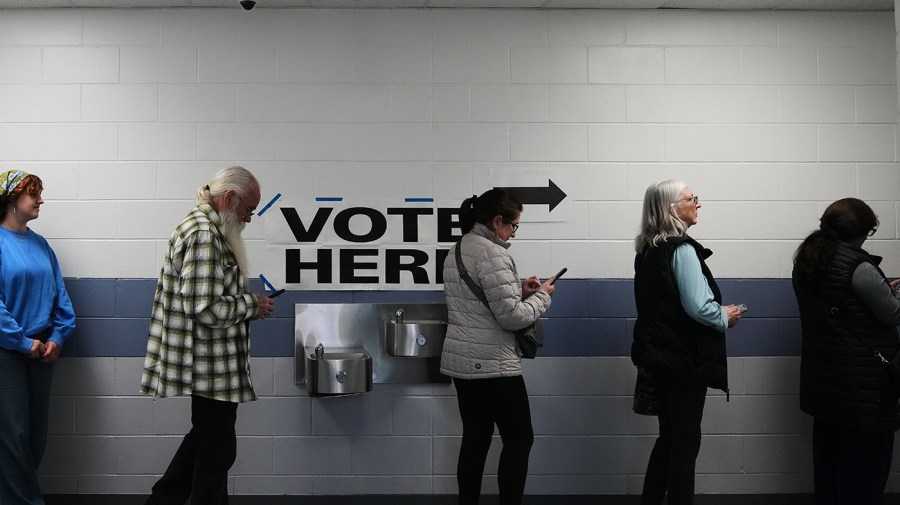
National Guard members in at least seven states will perform some sort of role during the highly charged midterm elections.
As Americans cast their ballots, plain clothes National Guard members will help monitor ballot boxes in seven counties across Washington state; monitor and defend election networks in Iowa; and assist with election cybersecurity in Colorado.
Those are just a few examples of the troops’ roles before and during Nov. 3’s midterms — an election that has received intense scrutiny as Democrats look to take back control of both chambers of Congress and President Trump has asserted he would do “anything necessary” to ensure honest elections.
A majority of Americans, however, do not think troops should be used at polling sites.
A new survey released by the Democracy and Security Network at the German Marshall Fund said those pushing back on the use of troops at the polls say it damages the public’s confidence in the military as an institution.
Loren Voss, one of the researchers who conducted the survey, said that out of the 2,800 Americans polled, 59 percent said that the president should not use the federal military to monitor or administer elections.
She told The Hill there is a generalized fear around federal interference in the elections, be it by a federalized National Guard presence, U.S. Immigration and Customs Enforcement (ICE) or FBI agents, and having members of the military help around polling stations only adds to that concern of interference.
“This is just another instance of using the National Guard for something that should be a civilian mission,” she said, concerning the presence of troops at ballot boxes in Washington state. “That is just so fraught for the potential of people thinking that there’s something untoward going on. You just shouldn’t take that risk.”
Federal law generally does not allow armed personnel to be stationed at a place where an election is being held — with the exception being if there is an attack on a polling location where federal force is needed.
But in the past several presidential and midterm elections, state governors have increasingly called on their National Guard to monitor cybersecurity and assist local authorities. In 2022, at least 14 states used their guard members — a number that rose to 15 in 2024.
This year, seven states have publicly acknowledged the Guard’s involvement in the midterms, with Washington state drawing the most attention after Gov. Bob Ferguson (D) last month offered counties an “Election Neighborhood Watch.” Seven counties took Ferguson up on his offer; the mobilization will consist of about 100 total National Guard troops.
Speaking to reporters Friday, Ferguson pointed to the 2024 incident when an unknown arsonist threw an incendiary device into a ballot box in Vancouver, Wash., damaging several hundred ballots. Then-Gov. Jay Inslee (D) activated the National Guard to assist after the event.
Ferguson also referred to recent reports of letters containing white powder sent to the secretary of State’s office and to several congressional offices.
We want to “just take every precaution we can to make sure that we’re protecting our voting system,” he said. “The National Guard — just so we’re clear — is called up routinely for elections, for cybersecurity and other things.”
Advertisement
In North Carolina, the National Guard’s Joint Cyber Security Task Force will help monitor election networks, along with the state’s emergency operations center, a National Guard official told The Hill. They added that their civil support teams are always on standby, but they have not been alerted at this time.
Colorado Gov. Jared Polis (D) in June ordered the state’s National Guard to assist with election cybersecurity — the only election support that the secretary of State’s office has requested at this time, The Hill was told.
Iowa’s guard members, meanwhile, will work alongside Iowa’s Secretary of State Paul Pate and state partners with its “specialized cybersecurity expertise, technical capabilities and operational experience to help identify potential cyber threats, strengthen defensive readiness and improve coordination among state agencies,” Brig. Gen. Mark Kappelmann announced last week.
The Alabama and Oklahoma National Guard troops have already been used after their specialists in October responded to two separate incidents where suspicious packages containing white powder were mailed to the Alabama secretary of State’s office and the Oklahoma State Election Board.
In Arizona, the state's National Guard's Cybersecurity Team are currently activated under state active duty orders "to provide standby support in coordination with the Arizona State Department of Homeland Security, should assistance be requested," according to spokesperson Maj. Erin Hannigan.
She added: "This posture is consistent with the Cyber Task Force’s traditional mission and does not represent a change in its normal operations."
Elsewhere, Democratic lawmakers have expressed concerns that the Trump administration may use the military or ICE agents to intimidate voters or election workers; contest the results of certain races; or seize voting machines or ballots. Trump, in a January interview with The New York Times, said he regretted not ordering the National Guard to seize voting machines in swing states after he lost the 2020 election.
Officials with the Department of Homeland Security (DHS) have said they do not plan to send ICE officers to patrol polling locations.
In Washington, D.C., meanwhile, the National Guard has been deployed by Trump since last year and will be on patrol Tuesday, though the city has asked the guard to limit the placement of troops near mail ballot drop boxes.
Sen. Elissa Slotkin (D-Mich.), a member of the Senate Armed Services Committee, sent letters in September to Attorney General Todd Blanche, DHS Secretary Markwayne Mullin, FBI Director Kash Patel and Gen. Steven Nordhaus, the chief of the National Guard, asking for a commitment to keep federal forces and law enforcement agents out of the midterm elections.
Gen. Dan Caine, chair of the Joint Chiefs of Staff, earlier in August assured Slotkin in a letter that there were no plans to send troops to seize materials related to the elections.
However, Defense Secretary Pete Hegseth in a Sept. 22 memo ordered military spy agencies to “mobilize every asset ... to defend our election” so that “every lawful voter can cast their ballot free from foreign intimidation, coercion, or fear.”
Trump also has refused to rule out invoking the Insurrection Act or declaring a national emergency around the midterm elections.
at 7:58 p.m. EST
Copyright 2026 Nexstar Media, Inc. All rights reserved. This material may not be published, broadcast, rewritten, or redistributed.
For the latest news, weather, sports, and streaming video, head to The Hill.
Source: “AOL Breaking”
